Home | Virginia
Politics
| National
Politics
Menu

Make a New Account

Username:

Password:


Forget your username or password?


Poll
How Enthused Are You About Tim Kaine for Senate?
Wildly Enthused, I LOVE Tim Kaine!
Strongly Enthused, I like Kaine a lot, Allen sux
Moderately enthused: Kaine's fine, Allen sux
Not enthused about Kaine, but Allen sux
Not at all enthused about this race
I'm voting for George Allen

Results

Weather

Search


Advanced Search


Blog Roll
Virginia Blogs
All Politics is Local
Augusta Free Press
Bacon's Rebellion
Coarse Cracked Corn
Crew of 42
DemRulz
Dixie Pig
Equality Loudoun
The Fix (WaPo)
Greater Greater Washington
The Green Miles
Leaving My Marc
Leesburg Tomorrow
Loudoun Progress
Moonhowlings
New Dominion Project
Not Larry Sabato
Off K Street
Old Dominion Blogs
Ox Road South Blog
Renaissance Ruminations
Richmonder
Richmond Sunlight
RTD VA Politics blog
Roanoke Times blog
Shad Plank
SlantBlog
Too Conservative
True Adventures of the Doorbell Queen
VB Dems
Virginia Education Report
WaPo - Virginia Politics Blog
Waldo Jaquith
Waldo's VA Political Blogroll

Progressive Legal Directory www.criminallawyervirginia.net
www.virginia-duilawyers.com
www.virginia-personalinjurylawyer.com
www.recklessdrivinglawyer.net
www.helpdisabilitylawyer.com
www.criminallawdc.com
www.duilawsdc.com

ADT Home Security in Virginia

"The idea that taxes are high right now is pretty much nuts"

by: lowkell

Tue May 11, 2010 at 12:26:25 PM EDT


Courtesy of USA Today:
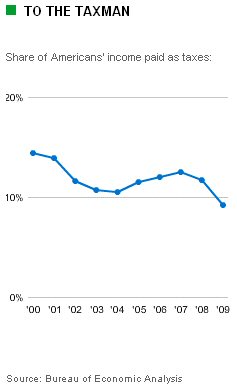
Amid complaints about high taxes and calls for a smaller government, Americans paid their lowest level of taxes last year since Harry Truman's presidency, a USA TODAY analysis of federal data found.

Some conservative political movements such as the "Tea Party" have criticized federal spending as being out of control. While spending is up, taxes have fallen to exceptionally low levels.

Federal, state and local taxes - including income, property, sales and other taxes - consumed 9.2% of all personal income in 2009, the lowest rate since 1950, the Bureau of Economic Analysis reports. That rate is far below the historic average of 12% for the last half-century. The overall tax burden hit bottom in December at 8.8.% of income before rising slightly in the first three months of 2010.

"The idea that taxes are high right now is pretty much nuts," says Michael Ettlinger, head of economic policy at the liberal Center for American Progress. The real problem is spending, counters Adam Brandon of FreedomWorks, which organizes Tea Party groups. "The money we borrow is going to be paid back through taxation in the future," he says.

Actually, the "real" problem - and this is most definitely NOT difficult to comprehend, unless you're trying not to comprehend - is our long-term, structural imbalance between expenditures (too high) and revenues (too low). On the expenditures side, it's almost all health care and other "entitlements" spending, plus the military and interest on the debt. Other than that, "non-defense discretionary spending" is tiny and not growing significantly, so even if we wanted to cut all our national parks, roads and bridges, agricultural subsidies, education spending, homeland security, etc., we'd still face the same structural problems (e.g., aging population, skyrocketing health care costs) we do now.

Which brings us to the revenues side of the equation, where we're at the lowest relative levels since 1950, despite fighting two wars (unpaid for), cranking up spending on "homeland security," and dealing with the aforementioned health care cost spiral. In short, as much as the "taxed enough already" crowd wants to complain, the fact - and it is a FACT - is that taxes are actually very low by historical standards. Not that this will get in the way of the right wingers' sob story; the facts rarely do with those people.

The bottom line is that, as much as conservatives think that all this is super complicated, a combination of rocket science and brain surgery, it's actually very simple. To solve our huge budget problem, we need to rein in rising health care costs, pay for the wars we fight and security we require, and stop implying that we can all have "something for nothing" while maintaining the lowest tax rates in 60 years.  Or, we can continue on our current path of borrowing from China and against future generations.  But that would be as "nuts" as "the idea that taxes are high right now."

lowkell :: "The idea that taxes are high right now is pretty much nuts"
Tags: , (All Tags)
Print Friendly View Send As Email

Spending is going up... (0.00 / 0)
...as a percentage of GDP, from 30% in 1960 to over 40% now.

Defense spending, however, has dropped from 10% of GDP in 1960, to less than 5% now (INCLUDING the spending on the GWOT).

Health Care, Pension, and Education spending have all expanded considerably.

So, which would you like to cut?  The programs that have grown considerably over the years, or those that have already shunk?  (Keep in mind that the deficit in 2009 was larger than the entire defense budget.)


The subject of the USA Today article (0.00 / 0)
was on the fact that taxes are the lowest since 1950.  Let's address that issue first.  After that, we can talk about how to rein in health care costs, which are the key driver of the rising deficit. We can also talk about how much of the defense and homeland security budgets ("good spending," according to Republicans like Bob McD) should be cut.  However, based on polling I've seen, Americans across the ideological spectrum don't want to cut ANY of this spending (except for foreign aid, which makes up a miniscule fraction of the budget), so good luck. Now, back to the "lowest taxes since 1950" issue...

Follow me on Twitter.

[ Parent ]
But they are NOT lower (0.00 / 0)
Total government revenue has gone from less than 30% of GDP in 1960 (closer to 25% in 1950) to over 35% of GDP now.

Now matter how that revenue is collected, it eventually comes from the people, either through direct taxes such as payroll, income, sales, and property taxes, or indirectly through tariffs and business taxes because we pay higher prices to cover the taxes.


[ Parent ]
Hmmmmm. (0.00 / 0)
Right off the bat, the source you're citing (Christopher Chantrill) makes me extremely suspicious of how these numbers were derived.  If my choice is believing the corporate media or believing a huge Sarah Palin fan, I'll take the corporate media any day!

Follow me on Twitter.

[ Parent ]
According to (0.00 / 0)
the Center on Budget and Policy Priorities, "Combined federal, state, and local revenues fell in fiscal year 2003 to their lowest level, measured as a share of the economy, since 1968."

According to the Office of Management and Budget (table 15.1, TOTAL GOVERNMENT RECEIPTS IN ABSOLUTE AMOUNTS AND AS PERCENTAGES OF GDP: 1948-2009), total government receipts were at 24.8% of GDP in 2009, compared to 20.7% in 1950, 25.2% in 1960, 28.3% in 1970, 27.8% in 1980, and 27.7% in 1990 (after a decade of Reagan and Bush as president). So, government receipts as a % of GDP today are LOWER than they've been since the late 1950s. Slightly different numbers than USA Today, but basically the same story...

Follow me on Twitter.


[ Parent ]
The State numbers from the Census Bureau (0.00 / 0)
Seem to be quite a bit higher than those of the OMB.  I wonder why that is.  Still, all those numbers you have are more than TWICE what the USA Today has.

So we have to ask ourselves, how much of our produce should the government be taking?


[ Parent ]
I'm not really sure what the answer is (0.00 / 0)
but these different series appear to be measuring different things. I'd have to spend a lot more time looking into this to understand why the series are different...

Follow me on Twitter.

[ Parent ]
Of course you know... (0.00 / 0)
...that is the definition of an ad hominem argument -- saying you distrust the source because he is a Sarah Palin fan, rather than looking into his numbers and the source of his numbers.  (BTW, he does provide links to the sources of his data, in the left side-bar, so you can check them yourself.  USA Today does not post such links.)  You will also note that the USA Today article does say that FICA taxes are not included.  That's 15.3% of most people's income right there.

Still, we can just go to the government itself, at least for the US government.  Here (table 1.3) for the receipts and outlays as a percentage of GDP.  As you can see, US gov't outlays in 1950 were 15.6% of GDP, and 19.5% in 2009.  Receipts (taxes by another name) were 14.4% of GDP in 1950, and 18.3% in 2009.

So unless State and local taxes are NEGATIVE, it can hardly be said that we are taxed at the lowest level since 1950.  That honor would go to 1959, when the US gov't took "only" 16.1% of our produce.

We can also go to US Census Bureau's Statistical Abstracts for the State data.  There, we see that State and local receipts (i.e., taxes) were $2,529B in 2005, which is quite close to the $2,154B the US gov't took in 2005.  Since the latter was 17.6% of GDP, we can calculate that the former was 20.6% of GDP, for a total of 38.2% of our produce that was taken by the government in 2005.

Now, which is closer to those numbers -- the USA Today report, or Mr. Chantrill?


[ Parent ]
I clicked on (0.00 / 0)
the link you provided, and what I found was that government receipts in 2009 were 18.3%. This is roughly comparable to where we were in 1952-1954 (19%, 18.7%, 18.5%), but higher than in 1950 (14.4%) and 1951 (16.1%). Basically, we're about at the same level as the 1950s, but it fluctuates around depending on what's going on (e.g., demobilization from World War II, the Korean War outbreak in 1950).  

Follow me on Twitter.

[ Parent ]
Aside from the varying psychological (0.00 / 0)
limits on what constitutes surrendering "too much" of one's "product" for common purposes through the government, there is the economic question of what reaches a level of adverse affect on the economy and on the social-political texture of the country. These are not the same.

During World War II and immediately thereafter, during the recovery years, we had a minor discussion of this subject, caused partly by the fact in the UK Churchill and the Conservatives were kicked out of office and replaced by Labor, which nationalized many industries, and established both the nationalized health service and affordable housing programs (to restore housing destroyed by the Blitz). Our economists and politicians were comparing British taxes with American. I wasn't paying all that much attention, but I seem to recall a consensus among various schools of economists that national government taxation slightly beyond 25 or maybe 28 percent of GDP was perfectly acceptable and would not damage innovation,  growth or productivity----- not merely in wartime but during peace as well. Adding in state-local you said brings us to 38.2 percent, which was at that time considered high but okay.... maybe we need to look at state and local tax systems as well?  


[ Parent ]
People seem to forget that the government used to not spend money (0.00 / 0)
on highways and Pell grants and EPA and NASA and certainly Social Security and Medicare/Medicaid.  I think we get a lot more now per-tax dollar than we used to.  

[ Parent ]
Advertising

Donate to Blue Virginia

About
The purpose of Blue Virginia is to cover Virginia politics from a progressive and Democratic perspective. This is a group blog and a community blog. We invite everyone to comment here, but please be aware that profanity, personal attacks, bigotry, insults, rudeness, frequent unsupported or off-point statements, and "trolling" (NOTE: that includes outright lies, whether about climate science, or what other people said, or whatever) are not permitted and, if continued, will lead to banning. For more on trolling, see the Daily Kos FAQs. Also note that diaries may be deleted if they do not contain at least 2 solid paragraphs of original text; if not, please use the comments section of a relevant diary. For more on writing diaries, click here. Thanks, and enjoy!

P.S. You can contact us at lowell@raisingkaine.com and you can subscribe to Lowell's Twitter feed here. If you'd like to subscribe to Miles Grant's Twitter feed, click here. For Teacherken, click here. For Kindler, click here.

P.P.S. To see the Blue Virginia archive, please click here. To see the Raising Kaine archive, please click here. To see the Blue Commonwealth archive, please click here.


RSS Feed

Subscribe to Blue Virginia - Front Page


Powered by: SoapBlox